Short answer gyroscope sensor how it works: A gyroscope sensor measures angular velocity by utilizing the principle of conservation of angular momentum. It consists of a spinning disk or wheel, whose orientation remains fixed when there is no external force or torque acting upon it. By measuring the changes in the orientation of the spinning wheel, the gyroscope sensor can determine rotational movements, such as pitch, roll, and yaw. This information is crucial for various applications like navigation systems and motion tracking devices.
- Understanding the Basics: How Does a Gyroscope Sensor Work?
- Step-by-Step Guide: Exploring the Inner Mechanism of a Gyroscope Sensor
- Frequently Asked Questions: Unveiling Mysteries about Gyroscope Sensor Operation
- Dive into the Science: Demystifying the Physics behind Gyroscope Sensor Functioning
- Practical Applications: Real-world Examples of How a Gyroscope Sensor Works
- Troubleshooting Tips: Common Challenges and Solutions in Operating Gyroscope Sensors
Understanding the Basics: How Does a Gyroscope Sensor Work?
Title: Demystifying the Mechanics: Decoding the Enigma of Gyroscope Sensors
Introduction:
Gyroscopes – these incredible, small devices that we encounter in everyday gadgets like smartphones and gaming controllers – have revolutionized how we interact with technology. But have you ever stopped and wondered about the captivating science that lies behind their flawless functionality? Let’s take a journey together as we delve into the fundamentals of gyroscope sensors, unraveling their secrets and demystifying their inner workings.
Unleashing Gravity-Defying Wisdom:
A gyroscope sensor is essentially a marvel of physics, designed to gauge rotational motion and maintain orientation in three-dimensional space. By defying gravity, it enhances navigation accuracy and enables various applications such as virtual reality experiences, drone stabilization, robotics, and more.
Capturing Angular Momentum:
At its core, a gyroscope sensor capitalizes on the principles of angular momentum. Remember your high school physics class? The law of conservation of angular momentum states that an object tends to maintain its current speed and direction unless acted upon by an external force. This fundamental principle forms the basis for how gyroscopes function.
The Ingenious Engineering Inside:
To comprehend how gyroscopes work, envision a wheel rotating on an axle. Integrated within this mechanism are tiny vibrating components known as MEMS (Micro-Electro-Mechanical Systems) gyroscopes. These minuscule structures exploit forces like Coriolis effect or vibrating mass displacement to measure rotation around any axis.
Coriolis Effect: A Phenomenon at Play:
When a wheel pivots around its axle due to external forces or device movements, the Coriolis effect comes into play within MEMS gyros. It manifests as vibrations caused by inertia during rotational motion changes. These disturbances result in minute displacements detected by specialized capacitors acting as sensors within the device.
Clever Capacitive Detection:
Within a gyroscope sensor resides an array of capacitors that detect the aforementioned displacements caused by the Coriolis effect. These capacitors measure variations in electric charge distribution, thereby intuitively quantifying rotational motion.
The Art of Data Interpretation:
Once the gyroscope sensor captures dynamic angular changes, it precisely converts this physical movement into electrical signals. Integrated circuitry subsequently interprets these signals to showcase real-time orientation updates, providing comprehensive data to the device or application utilizing it.
Calibration for Perfection:
To ensure optimal performance, gyroscopes often require calibration processes. This involves compensating for various environmental factors, including temperature variations and vibrations originating from external sources. Calibration guarantees utmost accuracy and reliability within a wide range of applications where precise measurements are critical.
Conclusion: Unraveling Gravity’s Little Helpers
In conclusion, gyroscope sensors operate on remarkable principles of physics, combining ingenious engineering with their ability to interpret inertial forces through clever capacitive detection. By harnessing angular momentum and capitalizing on phenomena like the Coriolis effect, these humble devices empower our digital world with an unwavering sense of direction and stability. So next time you use your smartphone or explore virtual realms through virtual reality headsets, remember to appreciate the intricate technology silently working behind the scenes – gyroscopes at their finest!
Step-by-Step Guide: Exploring the Inner Mechanism of a Gyroscope Sensor
Step-by-Step Guide: Exploring the Inner Mechanism of a Gyroscope Sensor
Welcome, technology enthusiasts and curious minds! Today, we embark on an exciting journey to delve into the inner mechanisms of a fascinating invention – the gyroscope sensor. Prepare yourself for an in-depth exploration filled with professional insights, witty observations, and clever explanations!
Now, you might be wondering what exactly is a gyroscope sensor? Well, my dear readers, it is a marvelous creation that exists within electronic devices to measure rotational motion. Think about your smartphone’s ability to automatically orient its screen based on how you hold it – yup, that’s all thanks to our trusty gyroscope sensor.
So let’s put on our metaphorical detective hats as we investigate how this nifty little device manages to achieve such accurate measurements. Follow me step-by-step as we unfold the mysteries behind its inner workings.
Step 1: The Core Concept – Stability in Motion
Picture yourself atop a spinning carousel – doesn’t that make you feel a bit wobbly? But fear not! Our gyroscopic hero comes to the rescue by utilizing a simple yet powerful principle called angular momentum. By maintaining stability in its rotational axis even when external forces act upon it, our sensor ensures precise measurement at any given moment.
Step 2: Anatomy Revealed – The Magic Lies Within
Gently pry open the casing of your smartphone (or well, maybe not literally) and you’ll find your gyroscope sensor tucked away snugly. Behold this tiny marvel comprised of three essential components: a sensing element known as MEMS (Micro-Electromechanical System), an oscillating proof mass nestled between capacitive plates, and microscopic electrodes responsible for detection.
Step 3: Classic Physics Strikes Back – Coriolis Force Takes Center Stage
Prepare for some physics terminology now because here comes Coriolis force! Once set in motion by changes in rotation around different axes, our gyroscopic friend experiences something called the Coriolis effect. This causes an apparent deflection in the motion of the oscillating mass, which can then be accurately measured to determine rotational changes.
Step 4: Precision at Its Finest – Sensing and Measurements
Now that we understand the Coriolis effect‘s magical role, let’s focus on how our sensor detects these minute movements. Those clever capacitive plates mentioned earlier act as electrodes, measuring tiny variations in capacitance as the proof mass undergoes its oscillations due to angular motion. These measurements are translated into precise data that your device can swiftly interpret.
Step 5: The Mastermind Chip – Sensor Integration and Data Processing
Every hero needs a trustworthy sidekick, and for gyroscope sensors, it’s the mastermind chip! Integrated within your electronic device (like a smartphone), this ingenious chip continuously processes the raw data picked up by our sensor. Through advanced algorithms and complex calculations, it transforms those measurements into meaningful information that helps your device react accordingly.
Congratulations! You’ve successfully completed our step-by-step expedition into understanding the intricacies of a gyroscope sensor. Armed with this newfound knowledge, you can now appreciate the wondrous technology responsible for enhancing your digital experiences.
Remember, dear reader, next time you see your smartphone smoothly rotate its screen or immerse yourself in gaming excitement dependent on movement detection – think of our trusty gyroscope sensor working diligently behind the scenes!
We hope you enjoyed this detailed professional exploration sprinkled with wit and clever explanations. Until next time, keep embracing curiosity and unraveling tech marvels!
Frequently Asked Questions: Unveiling Mysteries about Gyroscope Sensor Operation
Welcome to our blog section where we aim to unravel the mysteries surrounding gyroscope sensor operation! As technology continues to advance, understanding how these sensors work and their applications becomes increasingly essential. So, grab a cup of coffee and join us as we dive into some frequently asked questions about gyroscope sensor operation.
Q1: How does a gyroscope sensor work?
A gyroscope sensor measures angular velocity or rotational motion. It consists of a spinning rotor that maintains its axis of rotation due to the principle of conservation of angular momentum. When the device experiences rotational motion, gyroscopic forces act upon it, causing measurable deviations in the spin.
Q2: What are the applications of gyroscope sensors?
Gyroscope sensors have become ubiquitous in various industries, including aerospace, navigation systems, smartphones, gaming consoles, robotics, and virtual reality devices. They enable precise orientation detection for 3D augmented reality experiences and stabilization mechanisms for drones and cameras.
Q3: Can a gyroscope sensor be used for gesture recognition?
Absolutely! Gyroscopes can detect subtle movements and changes in orientation. Combined with other sensors such as accelerometers or magnetometers, they can accurately interpret gestures made by users. This concept revolutionized modern smartphones’ user interfaces with features like screen rotation or shaking movements for specific commands.
Q4: How do gyroscopes aid in navigation systems?
In navigation systems, gyroscopes play a crucial role in determining an object’s orientation even when GPS signals are weak or unavailable. Known as inertial navigation systems (INS), these rely on integrating gyroscope readings over time to calculate real-time position changes accurately.
Q5: Are all gyroscopes mechanical devices?
No longer limited to traditional mechanical designs using spinning mass rotors suspended by gimbal rings—modern-day gyroscopes utilize micro-electromechanical systems (MEMS) technology. These miniature solid-state gyroscopes offer high accuracy while being more reliable and cost-effective.
Q6: Are there any limitations or challenges associated with gyroscopes?
While gyroscopes offer exceptional precision, they are not entirely immune to certain limitations. For example, they can experience drift over time due to manufacturing imperfections or external factors like temperature variations. Regular calibration and sensor fusion techniques with other sensors help mitigate these issues.
Q7: Can a gyroscope sensor be used in autonomous vehicles?
Indeed! Gyroscopes are essential components in autonomous vehicles, providing critical data for precise motion planning and control systems. They enable highly accurate tracking of vehicle movements, ensuring safety measures and reliable self-driving capabilities.
So there you have it – a glimpse into the world of gyroscope sensor operation! These incredible devices continue to shape various industries and enhance our daily lives through their remarkable applications. We hope this blog has shed some light on the frequently asked questions surrounding gyroscope sensors while entertaining you with witty explanations along the way.
Until next time, keep spinning those mysteries away with your newfound knowledge of gyroscope sensors!
Dive into the Science: Demystifying the Physics behind Gyroscope Sensor Functioning
Have you ever wondered how your smartphone or gaming controller knows when to rotate in a certain direction? Or how those cool drone videos are filmed with such smooth movement? The answer lies within the tiny but powerful gyroscope sensor. In this blog post, we will dive deep into the realm of science and unravel the physics behind its functioning – demystifying the magic hidden behind these incredible devices.
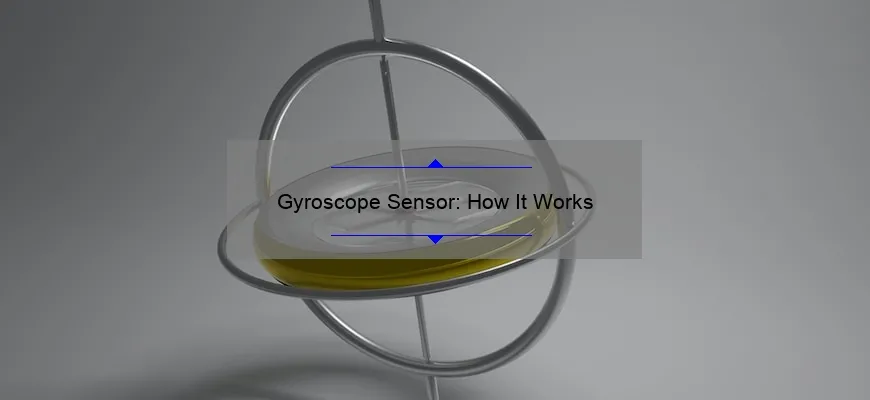
To understand the gyroscope sensor‘s operation, let’s start by defining what a gyroscope is. At its core, a gyroscope is a device that measures or maintains orientation and angular velocity. It consists of a spinning disc or wheel suspended in three rings – each positioned perpendicularly to one another. The principle of gyroscopic motion can be traced back to an inherent physical property known as angular momentum.
Angular momentum refers to the tendency of an object to resist changes in its rotation. When an external force acts on a spinning object, it tries to change its rotational axis. However, due to the conservation of angular momentum, the object resists this change by exerting an equal but opposite torque. This resistance creates stability and allows gyroscopes to accurately measure rotation.
Now that we grasp the concept of angular momentum, let’s explore how it applies to our beloved mobile gadgets and drones. Within a typical electronic device incorporating a gyroscope sensor, there are microscopic vibrating elements known as MEMS (Micro-Electro-Mechanical Systems) gyroscopes involved.
These MEMS gyroscopes utilize something called Coriolis effect – named after French mathematician Gaspard-Gustave de Coriolis – which takes advantage of inertial forces acting on objects in motion. Coriolis effect occurs when an object moves along a rotating system (such as Earth), resulting in apparent deflection from its intended path due to inertia.
In simple terms: when you rotate your smartphone or drone using your hand, for instance, tiny vibrating elements inside the gyroscope sense this rotation. As the device moves, the vibrating elements experience an inertial force proportional to their angular velocity. This force causes a displacement perpendicular to the direction of motion.
This displacement is then registered by microelectromechanical systems that convert it into an electrical signal. By analyzing these electrical signals, your phone or drone’s internal computer can calculate and detect changes in orientation and angular velocity accurately.
It’s intriguing how these minuscule sensors can provide such precise data, isn’t it? But wait, there’s more! To ensure optimal performance, modern gyroscopes often employ clever math algorithms and fusion with other sensors like accelerometers.
Accelerometers are devices responsible for measuring acceleration forces. By combining data from both gyroscopes and accelerometers, devices can better discern accurate information about motion along all three axes – pitch (tilt), roll (rotation around the long axis), and yaw (rotation around vertical axis). This fusion of sensor data enhances accuracy while compensating for any individual sensor limitations or measurement errors.
In conclusion, gyroscope sensors are revolutionary inventions that bring precision and stability to our mobile devices and drones. By harnessing the principles of angular momentum and Coriolis effect, they provide invaluable assistance in maintaining orientation and detecting movements accurately. So next time you marvel at your smartphone’s smooth display rotation or those awe-inspiring drone videos capturing breathtaking aerial shots, remember the intricate workings of these incredible gyroscope sensors tucked away inside.
Practical Applications: Real-world Examples of How a Gyroscope Sensor Works
In today’s technologically advanced world, it’s incredible how many gadgets and devices rely on gyroscope sensors to function seamlessly. From smartphones to virtual reality headsets, drones, and even medical equipment, the applications of gyroscope sensors are vast and ever-increasing. But have you ever wondered how these little marvels actually work?
To put it simply, a gyroscope sensor measures the rotational motion or orientation of an object. It relies on the principle of angular momentum, which states that an object in motion tends to maintain its state unless acted upon by an external force. Essentially, a gyroscope sensor senses any changes in rotation and provides accurate feedback to keep devices stable and aligned.
One practical application of gyroscope sensors is in our everyday companion – the smartphone. When you tilt your phone sideways to switch from portrait to landscape mode while watching a video or playing a game, it’s the gyroscope sensor at work. This tiny device detects the change in orientation and signals the display software to adjust accordingly, delivering an enhanced user experience.
Another impressive application is in virtual reality (VR) headsets. VR technology immerses users into digital environments that seem incredibly lifelike. To achieve this immersive experience, precise tracking of head movement is crucial for realistic visual rendering and interaction within these virtual worlds. A gyroscope sensor integrated into VR headsets tracks even the slightest movements of your head in real-time, making it possible for you to look around freely within the digital realm.
Moving onto more adventurous applications, drones heavily rely on gyroscope sensors for stabilization and smooth flight control. By constantly monitoring changes in rotation along three axes (roll, pitch, and yaw), a drone equipped with these sensors adjusts its propellers’ speed accordingly to ensure steady flight paths with minimal wobbling or drifting.
Even healthcare professionals benefit greatly from gyroscopic technology in various medical devices such as surgical robots and prostheses. For instance, when surgeons perform intricate procedures with robotic surgical assistants, they need precise control and stability. Gyroscope sensors play a vital role in maintaining the robot’s position and orientation, resulting in more accurate surgeries and reduced risks.
Additionally, prosthesis technology utilizes gyroscope sensors to provide enhanced mobility for individuals with limb loss. By detecting the user’s movements, these smart prosthetics can adjust their joint angles in real-time, allowing for more natural and fluid movements that closely resemble those of a biological limb.
In conclusion, gyroscope sensors have become indispensable components in modern technology across various industries. From our everyday smartphones to cutting-edge medical tools and beyond, these tiny devices enable precise rotational measurements and ensure stable operation. So next time you tilt your phone or immerse yourself in a virtual world, take a moment to appreciate the practical applications and fundamental impact of gyroscope sensor technology.
Troubleshooting Tips: Common Challenges and Solutions in Operating Gyroscope Sensors
Troubleshooting Tips: Common Challenges and Solutions in Operating Gyroscope Sensors
Operating gyroscope sensors can be a complex task, requiring precision and attention to detail. However, like any technology, they can encounter various challenges that may hinder their effectiveness. In this blog post, we will explore some common difficulties faced when working with gyroscope sensors and provide you with clever solutions to overcome them.
1. Calibration Issues:
One frequent problem encountered when operating gyroscope sensors is calibration errors. These errors can lead to inaccurate readings and compromised performance. To resolve this issue, it is crucial to ensure proper calibration of the sensor before usage. Follow the manufacturer’s guidelines precisely, paying close attention to factors such as temperature compensation or zero-rate level adjustments.
2. Vibration Interference:
Gyroscopes are sensitive devices that easily pick up vibrations from their surroundings. If your sensor is placed in a vibration-heavy environment, it may result in erroneous readings or noisy data. To mitigate this challenge, consider using damping materials or isolating mounting techniques while positioning the sensor. This clever solution effectively reduces external vibrations’ impact on the gyroscope’s accuracy.
3. Power Supply Problems:
A stable power supply is critical for optimal gyroscope performance. Insufficient power or fluctuations in voltage can cause irregularities in measurements and disrupt normal sensor operation. Always use a reliable power source adhering to the sensor‘s specified voltage requirements. Additionally, consider incorporating additional circuitry like voltage regulators or filters to maintain steadiness in your electrical supply.
4. Cross-Axis Sensitivity:
Cross-axis sensitivity refers to an undesired response of a gyroscope sensor due to inputs applied along axes other than intended. This challenge arises when there is interference between different channels of measurement within the same device package design or during PCB layout issues. A witty solution would involve careful placement of sensitive components on your printed circuit board (PCB) and reducing cross-talk by utilizing proper shielding techniques if necessary.
5. Temperature Drift:
Gyroscope sensors can exhibit variations in output readings affected by temperature changes. This phenomenon, known as temperature drift, can significantly impact measurement accuracy and sensor stability. To combat this challenge, incorporate temperature compensation algorithms to offset the adverse effects of varying temperatures on your gyroscope’s performance. Implementing these advanced calculations cleverly ensures reliable outputs across a wide range of operating conditions.
6. Noise Filtering:
Noise is an omnipresent obstacle that affects gyroscope measurements, making it difficult to extract meaningful data from the sensor’s output. Employing intelligent noise filtering techniques during data processing can help eliminate unwanted noise signals and enhance the overall signal-to-noise ratio. Utilize digital filtering algorithms or software-based methods to cleverly reduce noise interference while preserving critical information from your gyroscope sensor.
In conclusion, operating gyroscope sensors may present various challenges that can hinder their accurate performance. However, by implementing these troubleshooting tips and clever solutions discussed above, you can overcome common obstacles faced in gyroscope usage effectively. Remember that thorough calibration, careful placement of components, stable power supply management, temperature compensation algorithms implementation, and sophisticated noise filtering are fundamental steps towards achieving optimal gyroscope operation and precise measurement data acquisition.